Monday, June 8, 2015

Early Literacy Skill Set 4: Vocabulary

Researchers say that there are six skills that are important for children to learn before they are ready to read: Print Motivation, Print Awareness, Narrative Skills, Vocabulary, Letter Knowledge, and Phonological Awareness (Source: Every Child Ready to Read via Saroj Ghoting).  These are known as early literacy skills, sometimes referred to as emergent literacy skills.


What does vocabulary refer to in terms of early literacy?  Vocabulary skills encompass knowing the names of things, concepts, feelings, and ideas.  The larger a vocabulary a child has, the easier it  will be for him/her to learn to read.

Many board books created especially for infants have simple bold text describing the vocabulary for simple things that babies see every day- like bottle, mommy, toys, and teddy bear. Try reading a a lift the flap book like What Does Baby Love? by Karen Katz to help your little one identify familiar things around him/her.  As they get older, they will be ready to learn different words for feelings, concepts and ideas.  Try Grumpy Gloria by Anna Dewdney to see just how many different words there are to describe when you're feeling grumpy!

Nursery rhymes expose children to words that are not used in every day conversation.  When you Mother Goose for Babies.
read words that are unfamiliar to your child, you may have the urge to simplify text into words your child can understand.  Instead of doing this, read the written word and explain what it means. For example, if you are reading the old Mother Goose rhyme, "There was an old woman called Nothing-at-all, Who lived in a dwelling exceedingly small..." you should just pause and say that "dwelling" means home.  Find this rhyme and others in Arnold Lobel's


Another great place to start with learning vocabulary words is the human body.  Try reading Eyes, Nose, Fingers, and Toes: A First Book All About You by Judy Hindley.  It's also great to practice these words during bath time!  Then move on to basic concept books such as Blue Goose by Nancy Tafuri to learn colors.

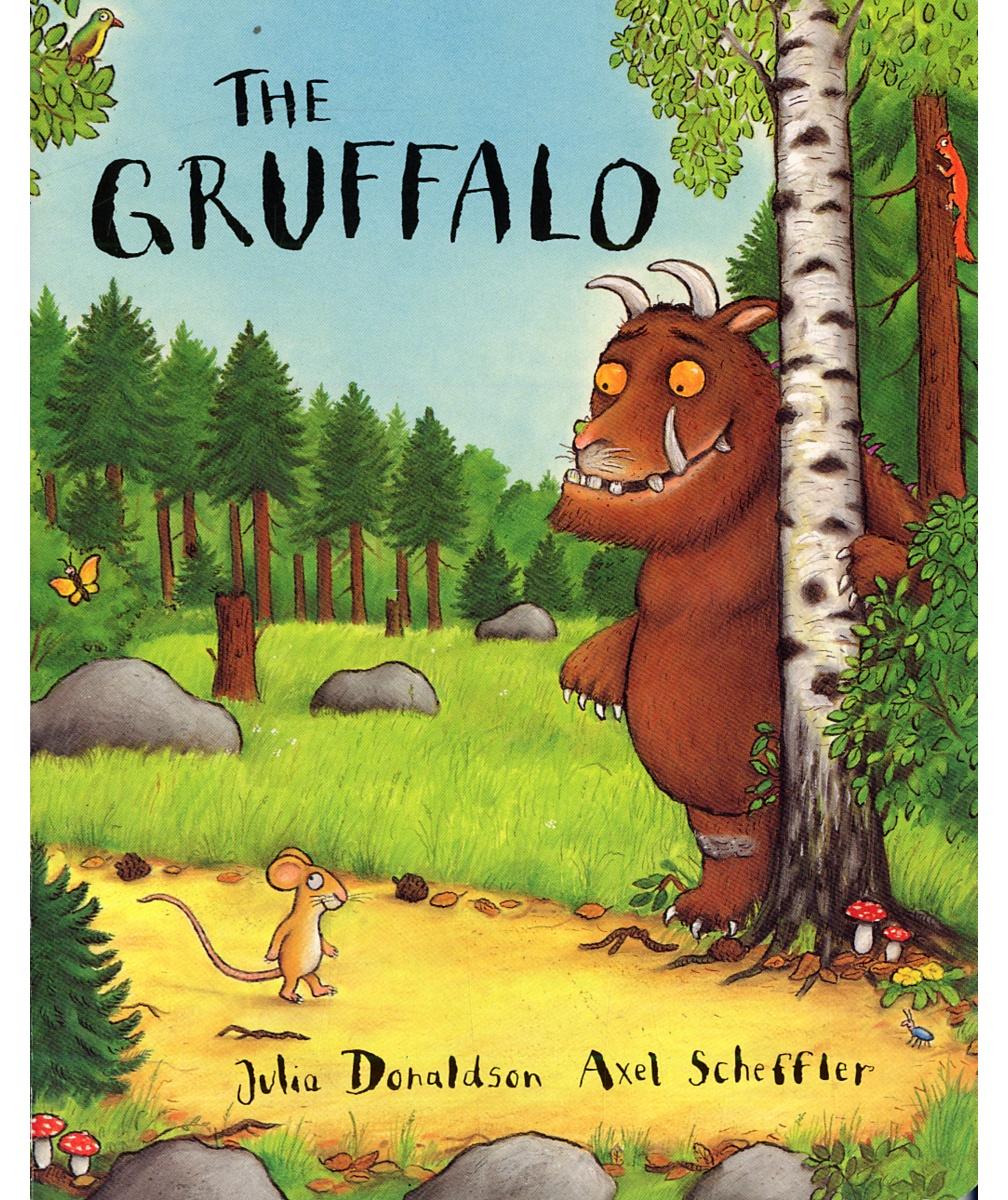
The more words your child hears, the larger his/her vocabulary willThe Gruffalo by Julia Donaldson (bonus for picking a book that has words not used in every day conversation!), go through the book a second time, but this time, don't read the words. Instead, talk about how the pictures tell the story.  Chances are you'll use new words and synonyms for the words you just read so that your child will learn even more new words.  A child's vocabulary is aligned with how many words they hear per day, so keep talking together!
be.  After you read aloud a picture book like

Saturday, May 30, 2015

Every Hero Has a Story


Summer Reading has begun!  Without a lot of spare time to come up with a display, I decided to use my friend Microsoft Publisher to whip up a "comic strip" display that summarizes our programming this summer, since the theme is "Every Hero Has a Story" and who doesn't like comics??!

Each panel of the comic was printed out on 11x17 paper and backed with construction paper.  


Say It Again!


Early Literacy Skills are competencies that children need to develop before they begin reading and writing.*

Choosing books to read with your child that have a repetitive phrase can aid in the development of many of the early literacy skills that children need in order to be ready to read: **

Print Motivation
Print Awareness
Narrative Skills
Vocabulary
Letter Knowledge
Phonological Awareness


Hearing a repeated phrase over and over again will help children recognize sound patterns and develop phonological awareness (understanding the smaller sounds in words).

Reading books with repeated phrases also helps children develop narrative skills (the skills needed to tell stories and describe events). In telling a story, pause and let your child complete the repeated phrase. Your child will gain confidence in participating and helping to tell the story.

Print awareness (noticing the fact that printed letters and words have meaning) can be developed by running your finger along the repeated phrase in a story.

As the old adage goes, practice makes perfect! Hearing these repeated phrases is wonderful practice for learning early literacy skills. Read these books with repeated phrases and remember it’s never too soon to be ready to read!

Caps for Sale by Esphyr Slobodkina

Shake your fists, and stamp your feet along with the peddler as he sells his caps and meets some silly and naughty monkeys along the way!

Chicka Chicka Boom Boom by Bill Martin Jr. and John Archaumbault

This classic and lively alphabet rhyme will have you chanting its memorable verses long after finishing the cheerful story. Lois Ehlert’s vibrant illustrations are not to be missed.

The Chick and the Duckling by Vladimir Suteev

This sweet mimicking tale of the newly hatched chick and duckling will delight little ones who are also exploring and discovering the world around them.

Clip-Clop
by Nicola Smee

Who wants to go for a ride with Mr. Horse? Children will love being bounced on your lap as you repeat “Clip-clop, clippety clop!” in this rhythmic tale of a horseback ride with barnyard friends.

Dear Zoo by Rod Campbell
Delight in the surprise of lifting the flaps to reveal who from the menagerie the zoo sends as a possible pet in response to a young child’s letter.

Have You Seen my Cat? By Eric Carle

Let’s help the little boy find his missing cat and meet helpful friends and other members of the cat family along the way! Children will love participating by repeating, “That is not my cat!”

I Went Walking by Sue Williams

In this repetitive question and answer book about the friends we meet when we go for a walk, children can participate by identifying each colorful animal.

It Looked Like Spilt Milk by Charles G. Shaw

The repetitive and simplistic nature of this picture book will keep children engaged and curious as they guess what each simple shape is illustrating.

The Napping House by Don and Audrey Wood

Read this gentle, cozy, cumulative rhyming story at bed time to ensure sweet dreams!

Pete the Cat: Old MacDonald Had a Farm by James Dean

Classic songs with repeated refrains are always a hit and children will enjoy seeing their cool friend Pete the Cat give an old song a new spin!

*(Source: National Center for Infants, Toddlers and Families, www.zerotothree.org).
** (Source: Every Child Ready to Read via Saroj Ghoting)


Wednesday, May 27, 2015

Dear Diary

Novels that are narrated in a diary or journal format provide a raw, intimate, and honest perspective. Readers are provided confidential details of the narrators’ deepest fears, desires, and secrets. Young adult novels in diary format are particularly of interest because the process of coming of age is so personal. This unfiltered perspective is something that the reader's inner voyeur cannot resist.

The Absolutely True Diary of a Part-Time Indian by Sherman Alexie

Being a teenager is tough— especially when you are Arnold Spirit, better known as “Junior.” Growing up in poverty on a Native American reservation, Junior decides to create a better future for himself by attending a school outside the “rez” -- even if doing so means his friends and family feel betrayed, and he does not fit in at his new all-white school. Junior’s sense of humor will keep you smiling in spite of his honest look at the difficulties of racism, family drama, and new beginnings.

Angus, Thongs, and Full Frontal Snogging by Louise Rennison

A year in the life of British teenager Georgia Nicholson will have readers laughing so hard, they may want to avoid reading this book in public. Georgia must navigate the throes of adolescence betwixt a loony little sister named Libby, a violent Scottish wildcat named Angus, and absurd parents whom she resentfully refers to as Mutti and Vati. Thank goodness she has her beloved Ace Gang of girlfriends to have hilarious adventures with as she falls in love
with Robbie (aka the Sex God), the lead singer of a local band.

Go Ask Alice by Anonymous

Alice has been shocking readers about the slippery slope of drug addiction since this diary's publication in 1971. What begins as a coming-of-age story about social acceptance and growing up turns into a terrifying account of the struggles of drug abuse that leads to homelessness, prostitution, an insane asylum, and eventually a fate worse than those aforementioned. Alice’s cautionary tale of addiction is not one you will soon forget.

Monster
by Walter Dean Myers

“Monster”: It’s the name given to Steve Harmon, a 16-year-old African-American boy, while on trial as an accomplice to murder. Steve tells his story of being in prison and on trial during in between journal entries and his own version of a screenplay— the cinematic story of his life. Watch the courtroom drama unfold to reveal the truth: Is Steve innocent? Was he framed by his so-called friends? Or was he simply in the wrong place at the wrong time?

Sloppy Firsts by Megan McCafferty

Meet Jessica Darling in the first of a series of five novels. Her story begins at age 16 when her best friend moves away, and Jessica must enter her sophomore year of high school alone. Readers will relate to Jessica in one way or another — for her self-proclaimed type-A personality, her humor and wit, her insecurities; and if all else fails, her unflinching honesty as new relationships develop and blossom.


Engineering with the Magic School Bus and Marshmallows


Another great STEAM (Science, Technology, Engineering, Art, and Math) programming idea borrowed from PBS Kids' Zoom Activities: build bridges out of toothpicks and marshmallows!  I gave children the building directive after we watched Magic School Bus Under Construction: Bridge Building.  

This program was simple, required very little preparation, and inspired great amounts of creativity and design concepts from elementary aged participants.  

To prepare, wrap two stacks of books (they must be the exact same books so that the stacks are an even height) in newspaper so you don't get sticky marshmallow residue on your library books.  This will serve as the base for your bridge.  

Watch the "Bridge Building" episode of The Magic School Bus Under Construction DVD (about 20 minutes long) and see Mrs. Frizzle's class create a bridge out of Q-tips and gum drops.

After the children see the Magic School Bus gang building a bridge, they will be eager to try doing so themselves.  Take a look at what our little aspiring engineers and architects created!  As an added challenge, once you get a bridge across your two stacks of books, add a paper clip attached to a cup and throw pennies in the cup to see how strong your bridge is.


Tuesday, April 14, 2015

Early Literacy Skill Set 3: Narrative Skills


Researchers say that there are six skills that are important for children to learn before they are ready to read: Print Motivation, Print Awareness, Narrative Skills, Vocabulary, Letter Knowledge, and Phonological Awareness (Source: Every Child Ready to Read via Saroj Ghoting).  These are known as early literacy skills, sometimes referred to as emergent literacy skills.

Narrative Skills include the ability to tell stories, as well as describing things and events. This skill set is important for reading comprehension; in simpler terms, grasping meaning from a story.

Remember that we are discussing early literacy skills; the skills that children develop before they can read and/or write, and that literacy starts at birth.  Your child is never too young to get ready to read!

Since your little one is not yet independently reading, its up to you to help him/her develop narrative skills.  The single most important thing you can do is read together (or attend storytime at your library)!

What can you do while reading together to boost narrative skills?

  • Read a book together twice.  During the second reading, talk about the illustrations.
  • Read a wordless picture book together, such as Hunters of the Great Forest by Dennis Nolan, and talk about the story that the pictures tell (children will "read" pictures before they read words, and pictures tell a story too)!
  • Read books with repetitive phrases, such as We're Going on a Bear Hunt by Michael Rosen and Helen Oxenbury, and pause and let your child complete the repeated phrase.
  • Tell a story with props.  Your librarian may use the flannel board to tell a story.  You can do the same with things you have around the house, like puppets and toys!
  • Read a book with a plot (that has a beginning, middle, and end) such as Harry the Dirty Dog by Gene Zion.
  • Try books with repetition in the plot, such as Paul Galdone's Three Billy Goats Gruff.
  • Choose a book that has a sequential or cumulative story, such as If You Give a Moose a Muffin by Laura Numeroff.

When you are choosing books, always pick something that YOU enjoy reading as well! Promoting the joy of reading should be present while learning every early literacy skill.  If you are enjoying yourself, your child will too!

Happy reading!


Sunday, March 22, 2015

DIY Snow Globes


What a fun craft this ended up being!  I would recommend it only for ages 12 and above.  Just having teenagers and myself doing the craft, our programming rooms still looks like a unicorn exploded in the sink.  Other than a little mess and a little practice, (and a little hot glue burn on my thumb), this craft was very simple.  We googled "how to make your own snowglobe", and purchased miniature glass jars (my colleague found a box of 20 for $20 in the wedding aisle of our local craft store!), a small bottle of glycerin, and lots and lots of glitter.  

I also decided to buy my own personal larger mason jar and merman figurine, because I wanted a merman snow globe.  Legit, right?  The snow globes themselves were assembled in a few easy steps:

Materials:
  • Small jars with lids
  • Figurines, photos, or magazines
  • Hot glue gun 
  • Glitter and/or sequins
  • Glycerin
  • Water
  • Felt and yarn, optional
Directions:

  • Glue your figurine (Harry Potter Lego guy, if you have it) with hot glue to the lid of the jar OR
  • Cut a picture (of Taylor Swift) out and laminate it with packing tape; glue to the back of the jar
  • Add glitter and/or sequins
  • Add one drop of glycerin 
  • Add water to top of jar
  • Screw on lid! As tightly as you can!
  • Shake it, shake it off
  • For upside down snow globes (where the lid is on the bottom), seal the lid with hot glue so that the water doesn't leak out.  
  • Optional: Rubber band a piece of felt around the lid of your jar, trim sides, and tie a piece of yarn around the base, as pictured in the merman snow globe.

My large merman snow globe ended up having to go without water because I couldn't seal it off without leaking.  Probably because I bought one of those mason jars with the two part lid! Oh, well. He will still be proudly displayed on my desk in all his glory.  Along with Taylor Swift and Harry Potter!